Baby Name Embroidery Singapore — How It Actually Works
Everything Singapore parents ask us about baby name embroidery — how the stitching is made, which fonts survive at bib size, how many characters really fit, whether Chinese characters work, how to wash it so the name outlasts the bib, and what it should cost here.
Baby name embroidery is machine stitching, not printing: the name is converted into a stitch file, the fabric is hooped over a stabiliser, and a dense satin stitch forms the letters through the cloth. On a baby bib, plan for up to 10 characters including spaces (three Chinese characters), letters around 12–15 mm tall, and polyester thread that survives daily washing. In Singapore, expect to pay S$5–10 per item at most embroidery shops — AEBaby includes it free on every bib, with a 2-working-day turnaround.
- A six-letter name is roughly 2,000–3,500 stitches and runs in 2–4 minutes on the machine
- Usable stitch area on a standard baby bib is about 9–10 cm wide
- 10 characters including spaces is the practical limit; 3–6 characters look best
- Chinese characters (汉字): maximum 3, at 15 mm or taller so strokes stay open
- Typical Singapore embroidery pricing: S$5–10 per item, often with a 3–5 piece minimum
- Embroidery outlasts print — heat-transfer names crack after roughly 12 washes
- AEBaby: free embroidery, no minimum, 2 working days + 1–2 days delivery
What Baby Name Embroidery Actually Is
Almost everything sold as "personalised" online falls into one of three categories, and they behave very differently after a month in a Singapore laundry basket.
Printed or heat-transfer names sit on top of the fabric. A vinyl film or ink layer is pressed on with heat, and it looks perfect on day one. It also starts cracking at the edges after roughly a dozen wash cycles, then lifts. In a household where bibs go through the machine almost daily, that is a matter of weeks, not years.
Woven or printed labels are stitched on as a separate tag. They last, but they add a stiff edge — not ideal against a newborn's chin or the back of a neck in humid weather.
True embroidery passes polyester thread through the cloth itself. There is no film, no adhesive and no separate layer to peel. The name becomes part of the fabric, which is why a properly stitched name generally outlasts the item it is stitched on. Every AEBaby bib is genuinely embroidered — never printed, never iron-on.
Almost all commercial baby name embroidery in Singapore is machine embroidery rather than hand embroidery. Hand work is lovely on a keepsake blanket, but it cannot hold the consistency or the wash durability you want on an item that gets soaked in drool three times a day. Machine embroidery gives you identical results across a set of six bibs and a stitch density that survives hundreds of washes.
The Embroidery Process, Step by Step
Understanding what happens between "type the name" and "open the parcel" explains most of the rules further down this page — especially the character limit.
1. The name becomes a stitch file
Text cannot be sent straight to an embroidery machine. It is first digitised — converted into a file (commonly .DST or .PES) that specifies every needle penetration, the stitch type, the stitch direction, the density, and the order in which the letters are sewn. Good digitising is why one shop's stitching looks crisp and another's looks furry at the same size.
2. Stabiliser goes behind the fabric
Cotton muslin has a deliberately open weave — that is what makes it breathable and fast-drying in our climate — but an open weave also shifts under the needle. A stabiliser is placed behind the stitch area to hold the cloth steady. On muslin, a light cut-away stabiliser holds better than a tear-away, and a wash-away topping on the surface stops the stitches sinking into the weave.
3. The fabric is hooped
The bib and stabiliser are clamped in a hoop so the fabric sits taut but not stretched. Hooping too tightly is the classic mistake: the fabric relaxes after the hoop comes off, and the stitching puckers. Position is set here too, which is why placement is fixed rather than freely chosen.
4. Underlay, then satin stitch
The machine first lays down light underlay stitches that lock the weave and give the letters a foundation. Then it covers them with satin stitch — the dense, slightly raised finish you see on hotel linen. A short name is roughly 2,000 to 3,500 stitches and takes two to four minutes to run.
5. Trimming and the reverse side
Jump threads between letters are trimmed, and the back is checked and finished so nothing rough sits against baby's skin. On a bib this matters more than on adult clothing — the stitch area is close to the chin and the neck.
6. Final check
Spelling is read back against the order, thread tension is checked for loops, and the piece is pressed from the reverse. At this point the bib is exactly what will arrive at your door, which is why a spelling error caught at the order stage costs nothing and one caught after stitching cannot be undone.
Fonts and Lettering Styles
Font choice looks like a style decision. At bib size it is mostly a legibility decision — a typeface that looks elegant at 40 mm can turn into a blur at 13 mm.
| Lettering style | How it reads at bib size | Minimum height | Best for |
|---|---|---|---|
| 🏆 Rounded script | Soft and legible; connected letters keep short names looking neat | 12 mm | Everyday bibs, gift pieces — AEBaby's house font |
| Block / sans-serif | Clearest of all; slightly less delicate | 10 mm | Long names, childcare labelling |
| Fine serif | Thin serifs fill in below 15 mm and look furry | 15 mm | Towels, blankets — larger stitch areas |
| Monogram (2–3 initials) | Very legible; loses the "it's clearly hers" effect | 18 mm | Keepsakes, formal gifts |
| Chinese characters | Needs more height than Latin letters — strokes close up when small | 15 mm | Full moon gifts, family keepsakes |
AEBaby uses one rounded script across everything we stitch. That is a deliberate choice rather than a limitation: it stays legible small, it suits both boys' and girls' colours, and it means a sibling bib ordered next year still matches the set you bought this year. Font libraries change; a single house font does not.
Character Limits — and the Maths Behind Them
The limit is not arbitrary. A standard baby bib gives you a usable stitch area of about 9 to 10 cm across, placed clear of the dribble zone and clear of the snap. Divide that by a letter height that stays readable from across a room — 12 to 15 mm — and you land at roughly ten characters before the letters start shrinking below comfortable.
| You type | Characters | Approx. letter height | How it comes out |
|---|---|---|---|
| Ava | 3 | 18 mm | Large and very legible — short names look best of all |
| Sophia | 6 | 15 mm | The sweet spot — fills the space without crowding |
| Xin Yi | 6 | 15 mm | Two-part names are fine — the space counts as a character |
| Muhammad | 8 | 13 mm | Fits comfortably; block lettering reads a touch clearer |
| Nur Aisyah | 10 | 12 mm | At the limit — still works, letters run smaller |
| Alexander | 9 | 12 mm | Fits, but "Alex" or "Xander" reads better on a small bib |
A useful rule: if the name is longer than eight characters, ask yourself what the family will actually call the child. The bib is worn for two years and the everyday name is almost always the better stitch. Full names belong on a keepsake towel, where the stitch area is three times larger.
Choosing a Thread Colour
Thread colour is the difference between a name you notice and a name you have to hunt for. Polyester embroidery thread holds its colour through hot washes and does not bleed onto cotton, but it does fade in direct sun — relevant here, where laundry often hangs on an HDB service-yard rack in full afternoon light.
| Bib colour | Thread that works | Effect |
|---|---|---|
| Indigo, Brick, Maroon, Olive Green | Cream or white | High contrast — the name is the feature. Best for gifts and photos |
| Pink, Blush Pink, Beige, White | Soft tonal shade | Understated, reads close up — the classic keepsake look |
| Pebble Grey, Pigeon Blue, Soft Green | Either — mid-tones take both | Most forgiving base if you're undecided |
| Printed bibs (Cherry, Flora, Teddy) | Picked from the print's own palette | Ties the name into the design instead of competing with it |
We match thread to the bib by default and place the name where it will not sit on top of a motif. If you want a specific colour — matching a full moon party theme, say, or a sibling's existing set — leave it in the order notes and we will follow it.
Chinese, Malay and Tamil Names
Singapore orders are not all Latin script, and each script has its own quirk at small sizes.
Chinese characters (汉字) embroider beautifully and are a natural choice for a full moon (满月) gift. The constraint is stroke density rather than width: a character like 慧 carries far more strokes than a Latin letter, and below roughly 15 mm those strokes begin to fill in and read as a blob. Three characters is our recommended maximum on a bib — that is a full Chinese name for most families. For a bib carrying both an English and a Chinese name, message us first and we will lay it out over two lines rather than cramming one. Gifting to a Mandarin-speaking family? Our 满月礼物新加坡 guide covers Chinese-name embroidery in Chinese.
Malay names embroider normally in Latin script. The practical issue is length — Nur Aisyah, Muhammad Danial and similar full names run past the ten-character limit once you include both parts. Most parents stitch the calling name (Aisyah, Danial) and keep the full name for the birth certificate.
Tamil and Indian names follow the same rule as Malay: transliterated into Latin script, with longer names shortened to the everyday form. Priyanka fits at eight characters; a full name with an initial prefix generally will not.
One thing worth saying plainly: type the name into the field exactly as you want it stitched, including capitalisation. We stitch what you type. If you enter it in lowercase, it comes back in lowercase.
What Can and Can't Be Embroidered
Not every baby item takes a name well. The fabric needs enough body to hold satin stitch, and the item needs a flat area big enough to hoop.
- ✅ Plain muslin bibs (S$5.99) — the clearest canvas, and what most people choose when the bib itself is the gift
- ✅ Double-layer snap bibs (S$5.99) — the extra layer gives the stitching a firmer base, so letters sit especially crisply
- ✅ Printed bibs (S$5.90) — lovely, though the print competes a little; we place the name to one side
- ✅ Muslin bath towels (S$19.90) — the largest stitch area we offer, and the one place a full name or a fine serif genuinely works
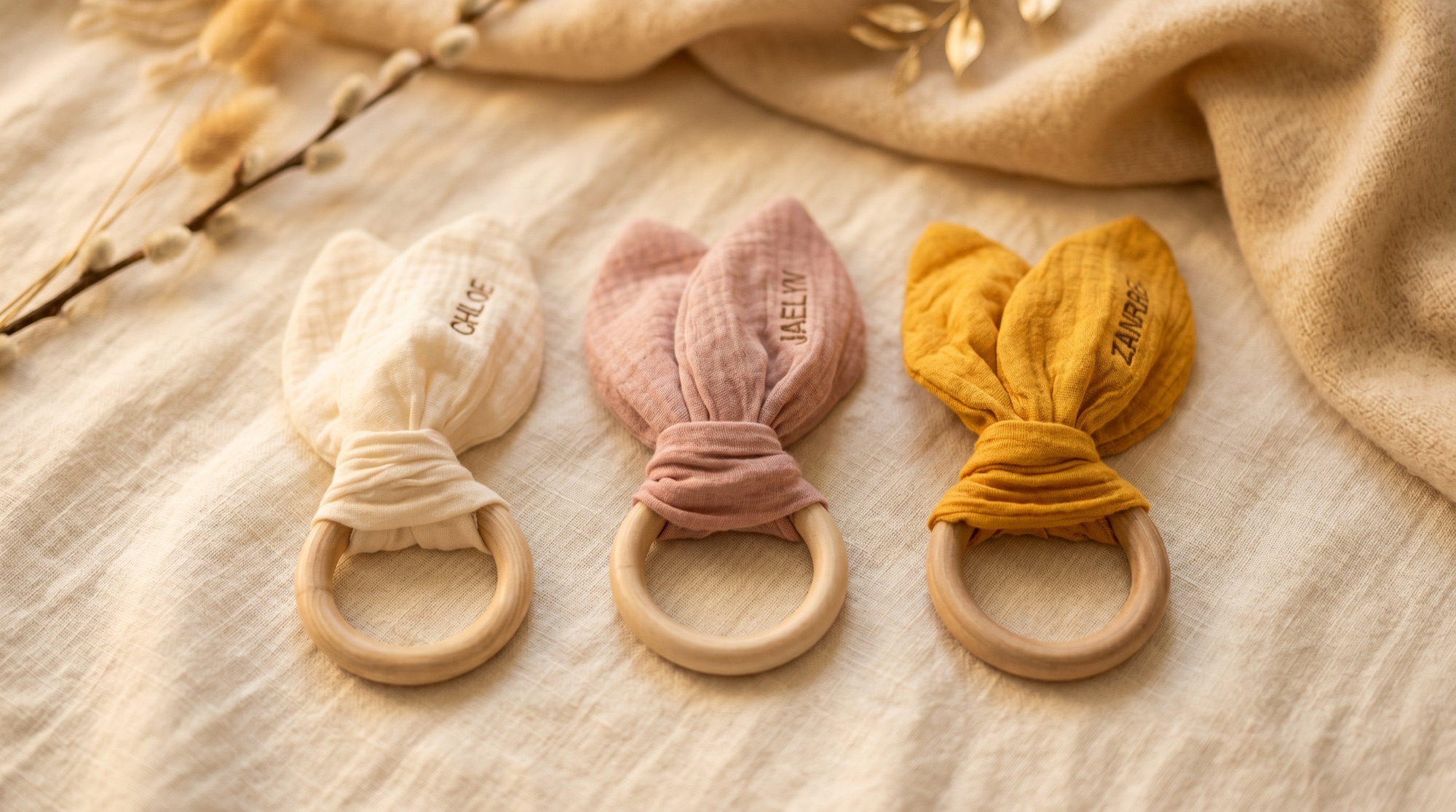
- ✅ Plain wood ring teethers (S$7.90) — the name goes on the plain muslin bunny-ear attachment, never on the beechwood ring
- ⚠️ Handkerchiefs (S$2.00) — possible, but the small hoop setup means we ask for a minimum of five pieces
- ❌ Printed teether attachments — the busy motif leaves nowhere for a name to read cleanly
- ❌ Anything a baby mouths directly — wood, silicone and hard surfaces are never stitched or engraved by us
Care Instructions — Making the Name Outlast the Bib
Embroidery is durable, but Singapore's climate puts specific stresses on it: constant washing, high humidity, indoor drying, and fierce afternoon sun on the drying rack. These seven habits are what separate a name that still looks new at month twelve from one that has gone fuzzy.
| Do this | Why it matters here |
|---|---|
| Wash at 30–40°C, gentle cycle | Hot washes shrink the cotton around stitching that doesn't shrink, which puckers the letters |
| Turn inside out, or use a mesh bag | Stops snaps and zips from other garments catching and pulling a thread loop |
| No bleach, including oxygen bleach | Strips colour from thread faster than from the base fabric — the name fades first |
| Skip the fabric softener | Coats the muslin and cuts absorbency — the whole point of a drool bib |
| Line dry in the shade | Direct SG sun fades coloured thread faster than washing does; shade drying still takes only a few hours here |
| Rinse before the basket | At 80–90% humidity a drool-soaked bib left in the basket grows mildew spots, and they settle in the dense stitch area first |
| Iron on the reverse, low heat | Pressing directly onto satin stitch flattens the raised finish and can glaze polyester thread |
Tumble drying is not fatal, but keep it low. The base cloth shrinks a little on high heat while the polyester thread does not, and the mismatch is what causes that slightly rippled look around older embroidery. For more on keeping muslin itself in good shape, our muslin bib washing and care guide has a section on named bibs, our guide to what muslin is and why it suits Singapore goes deeper on the fabric, and the cotton vs bamboo comparison covers drying time and cost per wear.
What Baby Name Embroidery Costs in Singapore
Pricing here splits fairly predictably by who is doing the stitching.
- General embroidery shops (uniform and corporate specialists, often in industrial estates or older malls): S$5–10 per item for a short name, usually with a 3–5 piece minimum and a setup fee if the design needs digitising.
- Specialist monogram studios: S$12–20 per towel or blanket, with more font and thread choice.
- Overseas online sellers: often cheaper per unit, but shipping takes one to three weeks, and a spelling error is effectively unfixable at that distance.
- AEBaby: free on every bib, single pieces included, no setup fee. Handkerchiefs need a minimum of five pieces.
The minimum-order rule is the thing that quietly rules embroidery out for most gift-givers. If a shop needs five pieces, a single named bib for a colleague's baby is not a realistic gift. Including the stitching in the S$5.99–S$5.90 bib price with no minimum is what makes a one-off personalised baby gift work here at all.
Timing Your Order Around the Occasion
Embroidery takes 2 working days at AEBaby, then 1–2 days for delivery anywhere in Singapore — three to four working days door to door.
Weekends are not working days, and that is what catches people out. A Thursday order for a Sunday full moon lunch is tight; the same order placed on Monday arrives comfortably. Five working days before the occasion is the number to aim for.
Two Singapore-specific timing notes. Full moon (满月) celebrations land 28 to 30 days after the birth, so you usually get plenty of warning — but the parents are often still finalising a Chinese name in week three, which is the real bottleneck rather than our queue. Baby showers here tend to be organised three to four weeks ahead, which is ample — our personalised baby shower gift guide works the timeline backwards from the party date. If the baby is not named yet, order the bib plain and message us on WhatsApp once the name is confirmed — we will embroider it later at no charge.
Checklist Before You Order
- ✅ Read the spelling back once. Stitched names can't be unpicked from muslin, so personalised items can't be exchanged for a spelling change.
- ✅ Count the characters, spaces included. Ten is the limit; under eight looks better.
- ✅ Use the calling name, not the full birth-certificate name, unless you're stitching a towel.
- ✅ Check the capitalisation in the name field — we stitch it exactly as typed.
- ✅ Three Chinese characters maximum, and tell us if you want English and Chinese on the same piece.
- ✅ Ordering for twins or siblings? Each item carries its own name field, so add them separately and nothing gets mixed up.
- ✅ Count back five working days from the event, not five calendar days.
- ✅ Not sure of the spelling on a surprise gift? A set with one plain and one named piece hedges nicely.
FAQ — Baby Name Embroidery Singapore
How does baby name embroidery work?
The name you type is converted into a stitch file that tells an embroidery machine where to place every needle penetration. The fabric is held taut in a hoop with a stabiliser behind it, the machine lays down underlay stitches to lock the weave, then covers them with a dense satin stitch that forms the letters. Jump threads are trimmed and the reverse is checked so nothing scratches baby's chin. On a small bib name, the machine run itself takes only two to four minutes — the preparation is the slow part.
How many characters can you embroider on a baby bib?
Ten characters including spaces is the practical limit on a standard baby bib. The usable stitch area is roughly 9 to 10 cm wide, and letters need to stay around 12 to 15 mm tall to read from across a room. Names of three to six characters — Ava, Sophia, Xin Yi — look best. Longer names still fit but the letters shrink, so a shortened form often reads better.
Can you embroider Chinese characters on a baby bib in Singapore?
Yes. Chinese characters (汉字) embroider beautifully, and we recommend a maximum of three characters so each one stays large enough to hold its strokes. Characters with many strokes need more height than Latin letters — below about 15 mm the fine strokes start filling in. Malay and Tamil names embroider normally in Latin script; long ones such as Nur Aisyah or Muhammad simply run at a smaller letter size.
How much does baby name embroidery cost in Singapore?
Most embroidery shops in Singapore charge S$5 to S$10 per item for a short name, and many set a minimum of three to five pieces. Specialist monogram studios charge more for towels and blankets, typically S$12 to S$20. AEBaby includes name embroidery free on every bib with no minimum order, so a single embroidered bib at S$5.99 works as a small gift in a way it usually does not elsewhere.
How do you wash embroidered baby clothes so the name lasts?
Wash at 30 to 40°C on a gentle cycle, turned inside out or in a mesh laundry bag, with no bleach and no fabric softener. Line dry in the shade rather than in direct Singapore sun, which fades coloured thread faster than washing does. Iron on the reverse at low heat and never press the iron directly onto the stitching. In our 80 to 90 per cent humidity, rinse a drool-soaked bib before it goes into the basket so it does not sit damp and develop mildew spots around the stitch area.
Is embroidery better than printed or iron-on names?
For baby items, yes. A printed or heat-transfer name sits on top of the fabric and begins cracking and peeling after roughly a dozen washes — a matter of weeks in a Singapore household where bibs go through the machine almost daily. Embroidery is stitched through the cloth with polyester thread, so it survives the wash cycle, the humidity and the drying rack, and typically outlasts the item it is stitched on.
How long does name embroidery take in Singapore?
At AEBaby, embroidery takes 2 working days, then 1 to 2 days for delivery anywhere in Singapore — 3 to 4 working days door to door. Weekends are not working days, which is what catches most people out: a Thursday order for a Sunday full moon lunch is tight. Aim for five working days before the occasion, and message us on WhatsApp first if you are genuinely down to the wire.
Final Thoughts
Baby name embroidery is a small piece of craft with a few hard constraints — stitch area, letter height, thread behaviour — and once you know them, ordering well is straightforward. Keep the name short, pick contrast over subtlety if it is a gift, wash cool and dry in the shade, and count working days rather than calendar days.
Do that, and the name outlasts the bib, the teething phase, and usually the child's memory of ever wearing it. That is rather the point of a keepsake. 💕
Next: see the full personalised baby bib range, browse baby girl bib colours, or start with our complete baby bibs Singapore guide if you are still deciding on types and sizing.